 Send Inquiry
 Send SMS
 Call Me Free
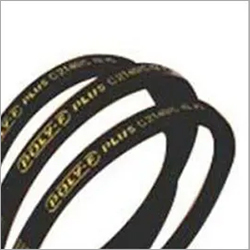
Fenner V-Belt
200.00 - 1000.00 INR
Product Details:
- Usage Transmission
- Color Black
- Length 100-200 Meter (m)
- Click to View more
X
Fenner V-Belt Price And Quantity
- 10 Piece
- 200.00 - 1000.00 INR
Fenner V-Belt Product Specifications
- 100-200 Meter (m)
- Transmission
- Black
Fenner V-Belt Trade Information
- Cash on Delivery (COD), Cash in Advance (CID), Cheque, Cash Advance (CA)
- 1000 Piece Per Week
- 10-15 Days
- All India
Product Description
FENNER V-BELT
The fenner v belt manufactured by us come with dual duty grooves in order to match perfectly classica V and Spacesaver wedge belts. Furthermore, the belt has standard range caters to drive up to 200 KW with the speed ratios up to 1:7. The v belt comes in over whopping 470 standard sizes in order to cater the wide range of clients requirement. Moreover, the belt is quality tested at every stage of production to ensure its high functional value. The Fenner V Belt is available at cost-effective rates and delivered within the stipulated time period.
The key features of the belt are as follows:
- More than 470 standard sizes
- Dual Duty Grooves
- Long Shelf Life
- Cost-effective rates
Fenner/PIX
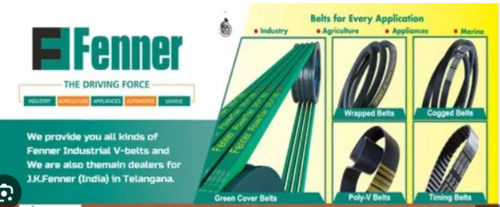
- Classical Vbelts Sectionsfhp, A,B,C,D & E
- Space Saver Wedge Belts Sectionsspz, Spa,Spb,Spc,3v & 5v
- High Capacity Delta Vbelts Sections8v/25 N
- Banded Belts Classical & Wedge Sectionsbands Of 2 T0 6
- Timing Belts Sectionsxl, L,H,Xh,5m,8m & 14m
- Hexagonal Blests Sectionsaa, Bb & Cc
- Harvester Combine Belts Sections36 X 14, & 50 X 22
- Raw Edge Cogged & H.E.M.M Belts Sectionsax, Bx,Cx,Spzx,Spax,Spbx,Spcx,15a,17a & 20a
- Multi Rib/Poly Vbelts Sectionspj, Pk,Pi & Pm
- Secial Belts Vcrested Belts,Profile Belts & Bowling Belts
Some of the features are as follows
- Dual Duty Grooves to perfectly match classica V and Spacesaver Wedge Belts
- Standard range caters to drives upto 200 Kw with speed ratios upto 1:7.
- Over 470 standard sizes to cater lo wide range of requirements.
Versatile Transmission Solutions
Fenner V-Belts are engineered for diverse industrial use, particularly excelling in transmission applications and conveyor systems. Crafted from high-quality rubber, these belts effectively transfer power while absorbing shocks and vibrations, ensuring smooth operation in challenging environments. Their black color and flat belt design are optimized for consistent traction and long-lasting performance, meeting the demands of both belt and roller conveyor mechanisms.
Dependable Manufacturing and Supply Network
Based in India, Fenner operates as an exporter, importer, manufacturer, supplier, and trader of V-Belts. The company's extensive network allows it to offer flexible logistics and on-time delivery, ensuring that industries receive the right products when needed. The wide availability and trusted sourcing make Fenner V-Belts a dependable choice for numerous applications across domestic and international markets.
FAQ's of Fenner V-Belt:
Q: How are Fenner V-Belts used in transmission and conveyor applications?
A: Fenner V-Belts are primarily used to transmit mechanical power in machinery and to facilitate material movement in conveyor systems. Their flat design and rubber material provide efficient power transfer and traction in both belt conveyors and live powered roller conveyors.Q: What materials are used in the construction of Fenner V-Belts?
A: These belts are made from high-quality rubber, offering durability, flexibility, and resistance to wear, making them suitable for rigorous industrial applications.Q: When should Fenner V-Belts be replaced in a conveyor system?
A: It is recommended to inspect the V-Belts regularly for signs of wear, cracks, or stretching. Replacement intervals depend on operational hours and load conditions but generally should occur every few years or earlier if noticeable deterioration occurs.Q: Where can Fenner V-Belts be sourced in India?
A: Fenner V-Belts are widely available across India through the company's network as an exporter, importer, manufacturer, supplier, and trader. They can be procured from authorized distributors or directly from Fenner's sales channels.Q: What is the process for installing a Fenner V-Belt on a conveyor system?
A: To install, first ensure the machine is powered off. Remove the old belt, align the new Fenner V-Belt on pulleys or rollers, and adjust the tension according to manufacturer guidelines. Test the conveyor for proper operation before resuming full use.Q: What are the main benefits of using Fenner V-Belts in industrial settings?
A: The main advantages include reliable power transmission, reduced maintenance due to their robust construction, flexibility across multiple applications, and consistent performance, leading to lower operating costs and increased productivity.Tell us about your requirement

Price:
Quantity
Select Unit
- 50
- 100
- 200
- 250
- 500
- 1000+
Additional detail
Mobile number
Email

Other Products in 'Fenner V Belts' category

Contact Details

- 67/69, Mohamedali Road, Dada Manzil Building 2nd Floor, Masjid Bunder (West),Mumbai - 400003, Maharashtra, India
- Phone :08045476068
GST : 27AABPV0855D1ZS

- Mr Bhavin Bhupatbhai Vora (Proprietor)
- Mobile :08045476068
- Mr. Milin Vora
- Mobile :08045476068
- Send Inquiry
 Send Inquiry
|


 |
ARIHANT TRADING CO.
All Rights Reserved.(Terms of Use) Developed and Managed by Infocom Network Private Limited. |
